One Training Library, Many Clients: Keeping BPO Training Consistent Without Duplicating Work
 Admin Eduqat8 min read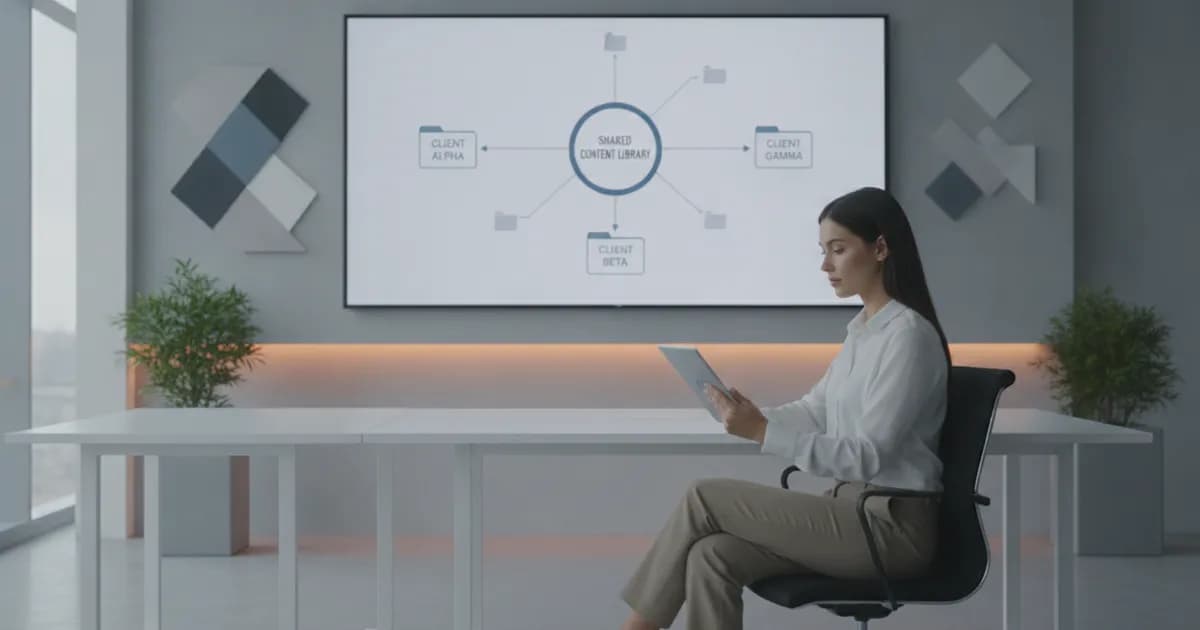
Centralizing BPO training content across multiple accounts means building one master library of core skills, process knowledge, and compliance material, then layering client-specific scripts, tools, and SLAs on top of it instead of rebuilding a full course for every new account. The master library stays in one place. Only the account layer changes.
A training manager at a mid-sized BPO opens her content folder on a Monday and starts counting: fourteen separate onboarding decks, one per client account, each edited by a different trainer over the past eighteen months. Half of them still reference a refund policy two clients retired last year. Nobody owns the decks as a set, only as individual files, and nobody has time to reconcile fourteen versions of the same soft-skills module before the next hiring cohort starts Thursday.
This is the quiet cost of scaling a BPO by account rather than by capability. Every new client contract adds headcount pressure to the training team, and the fastest way to hit a launch date is to copy the nearest deck and edit it. Do that enough times and the organization is no longer running one training operation with many clients. It is running many small, disconnected training operations that happen to share a logo.
What "Centralizing Training Content Across Accounts" Actually Means
In practice, centralizing training content is a two-layer model, not a single shared course. One layer holds what stays the same no matter which client the agent is supporting. The other holds what changes.
| Layer | What lives here | Changes when |
|---|---|---|
| Master library | Core systems training, soft-skill fundamentals, de-escalation frameworks, brand-neutral communication standards, baseline compliance | The underlying skill, tool, or regulation itself changes |
| Account layer | Client-specific scripts, macros, SLAs, escalation paths, client vocabulary, product or policy detail | Every time a client's process, tooling, or contract changes |
The master library is built once and maintained by a small, accountable group. The account layer is thin by design: a short addendum, not a parallel course. When a new client signs, the training team assembles their onboarding from the master library plus a lighter, faster-to-build account layer, rather than starting from a blank document.
Why Duplicate Libraries Pile Up in the First Place
Duplication rarely starts as a decision. It starts as a shortcut. A trainer under deadline copies the closest existing deck, renames it for the new client, and edits the parts that obviously need to change. That trainer moves to another project, the deck sits untouched, and six months later a compliance update lands in the master content but never makes it into the copy.
Multiply that across a dozen accounts and the training team is no longer choosing to duplicate content. They are maintaining an accidental fleet of near-identical documents, each one slightly out of date in a different place. If your team has already worked through how to standardize onboarding across multiple client accounts without growing headcount, this is the layer underneath that problem: standardization only holds if the content itself has one source of truth to standardize from.
The Core Structure: Master Library Plus Account-Specific Layers
The fix is architectural, not just procedural. Content gets built once at the master level and referenced, not copied, by every account.
This pattern is close to what training-delivery platforms sometimes describe as a multi-tenant approach: one back-end content library serving multiple client-facing sites, as some LMS providers frame it, each with its own access rules, branding, and reporting. You do not need that specific technical architecture to apply the underlying discipline. What matters is that updates to shared content propagate automatically to every account using it, instead of requiring someone to manually re-edit fourteen files.
The real cost in a duplicated system is rarely the first build. It's the maintenance drift afterward. Every policy change, every new tool rollout, every refreshed compliance requirement has to be manually re-applied to every duplicate, and the more accounts you run, the more places a single update can quietly fail to land.
What to Standardize vs What to Keep Client-Specific
Not everything belongs in the master library, and treating client-specific detail as if it were universal creates its own failure mode: agents confidently giving a client-A answer to a client-B customer. A simple test helps sort content correctly.
Always standardize (belongs in the master library):
- Systems navigation and platform basics shared across accounts
- De-escalation, tone, and communication fundamentals
- Code of conduct, data handling basics, and baseline compliance training
- Core product-agnostic troubleshooting logic
Templated but tunable (shared skeleton, client fills the variables):
- Call scripts and macros, where the structure is reusable but the wording is client-specific
- QA scorecards, where the criteria categories are shared but the weighting may shift by account
- Knowledge-check quizzes, where the question format is standard but the content pulls from that account's SOPs
Always client-specific (never generalize):
- SLAs, escalation paths, and named contacts
- Client tools, credentials, and system access
- Regulatory requirements tied to that client's industry or geography
- Brand voice and terminology the client has explicitly required
The decision rule that keeps this from becoming a judgment call every time: if two different clients would want their agents to give the exact same correct answer to a given question, that content belongs in the master library. If the correct answer depends on which client the agent is currently supporting, it belongs in the account layer.
Where AI Changes the Calculus
The layering model above is not new. What has changed recently is how much labor it takes to maintain the account layer once it exists. AI-assisted training tools now let a training lead upload a client's process document or SOP and generate a structured lesson, quiz, or practice scenario from it in a fraction of the time a manual instructional-design pass would take. Practice sessions can be graded automatically and routed into a per-account view, so a supervisor can see which agents on which accounts still have gaps without sitting in on every roleplay personally.
This does not remove the need for the layering discipline described above. An AI tool that generates content quickly from a messy source document will just as quickly generate fourteen more slightly-different documents if nobody is enforcing which parts of that output belong in the master library versus the account layer. The tooling reduces the labor cost of maintenance. It does not replace the governance decision about what gets maintained where.
Rolling It Out Without Disrupting Live Accounts
Rebuilding an entire training library from scratch, live, across every running account is how these projects stall. A narrower rollout sequence tends to hold up better in practice.
- Audit what exists. Inventory every current deck or module by account and tag which sections are functionally identical across accounts versus genuinely client-specific. Most teams find the identical portion is larger than expected, often 60 to 80 percent of total content, though the exact ratio depends on how regulated and how varied your client mix is.
- Extract the master library from your cleanest account first. Start with whichever account has the most current, best-documented training material rather than trying to average across all of them at once.
- Pilot on your next new-account onboarding, not a mid-cycle change to a live account. A brand-new client has no existing training habits to disrupt.
- Build the account layer as a short addendum, not a parallel course. If the account layer is longer than the master-library reference material, that is a signal too much client-specific content has crept into what should be standardized.
- Set a review trigger tied to events, not a calendar guess. Contract renewals, compliance updates, and tooling changes are the moments content actually goes stale. A generic quarterly review often catches problems too late.
Governance: Keeping the Library From Drifting Again
Structure without ownership decays back into duplication within a year. Two governance habits matter more than the platform choice.
First, assign a single accountable owner for the master library, separate from the account leads who own only their client-specific layer. When a compliance update or process change lands, that owner is responsible for updating the master content once, rather than trusting fourteen account leads to each remember to apply it.
Second, plan for the compliance and access-control edge case early. Some accounts, particularly those in healthcare-adjacent, financial, or other regulated spaces, will have material that legitimately cannot sit in the same access tier as a retail client's return policy, even if the training method behind it is identical. That is a security and audit constraint, not an argument against centralizing everything else. The workaround is usually a segmented access structure within the same library system, not a fully separate library for that one account.
Frequently Asked Questions
What's the difference between a training library and a training portal? A training library is the content itself: the modules, scripts, and assessments. A training portal is the interface where learners access that content, which may be organized per client account with its own branding, permissions, and reporting even when it pulls from a shared underlying library.
How many client accounts justify centralizing training content? There is no fixed threshold, but the pain typically becomes obvious around three to five active accounts, once manually keeping duplicate decks in sync starts consuming more time than the original build did. Teams below that scale sometimes centralize proactively to avoid the cleanup later.
Does centralizing training content mean every client gets identical training? No. Centralizing separates what is genuinely shared (systems basics, communication standards, core compliance) from what is client-specific (scripts, SLAs, tools). Clients still receive training tailored to their process. What changes is where the shared portion lives and how many times it gets rebuilt.
How do you handle compliance requirements that differ by client? Client-specific compliance requirements belong in the account layer, not the master library, and in some cases need separate access controls for audit purposes. Baseline compliance training that applies regardless of client (data handling basics, code of conduct) can still live in the shared library.
Who should own the master training library? A single accountable owner, typically a training operations lead rather than an individual account trainer, works better than shared or rotating ownership. Account leads then own only their thinner, client-specific layer, which keeps update responsibility clear when something changes.
Key Takeaways
- Centralizing training content across accounts means separating a master library (skills and process knowledge that don't change by client) from a thin account layer (scripts, SLAs, tools that do).
- Duplicate libraries usually start as a reasonable shortcut, copying the nearest deck under deadline pressure, that nobody owns long enough to prevent drift.
- A simple sorting rule works better than case-by-case judgment calls: if two clients would want the same correct answer, it belongs in the master library.
- AI-assisted content tools reduce the labor of building and updating the account layer, but they don't replace clear ownership or a change-triggered review cadence.
- Rolling this out account by account, starting with a new client onboarding rather than a live account, holds up better than attempting a full rebuild at once.
- Regulated accounts may need segmented access within the same system rather than a fully separate library, which is a security decision, not a reason to abandon centralization elsewhere.
If you want to see what the master-library layer looks like once AI is doing more of the maintenance work, Eduqat lets you upload a process document or SOP and turns it into a structured lesson, quiz, or practice scenario your team can use, the kind of asset that gets expensive to keep updating by hand across a growing account list. You're welcome to explore what the platform does or try the free demo with one of your own documents to see how much of that layer it can help carry.