Eduqat Article
Insights on AI-powered education, course creation, and corporate training.

Questions to Ask a Training Tool Vendor Before You Sign
A training vendor's sales deck rarely mentions what happens six months in, after the launch discount ends and the account manager who ran your demo has moved to a different territory. That is usually the moment it becomes clear whether the platform was actually a fit, or just a good pitch. For L&D teams running training across several outsourced or client accounts at once, the gap between "looked great in the demo" and "works the way we actually operate" tends to be wider than for a single in-ho

See How AI Course Generation Turns Existing Materials Into Training Content
A training manager sits through her third AI course generator demo of the month. The first two followed the same script: a clean sample document, a polished output nobody could poke holes in, and a sales rep who moved fast past the question of what happens with an actual client SOP, the messy one with tracked changes and a policy exception buried on page nine. She has learned to distrust a demo that never touches her own material. That instinct is correct, and it is the reason this article exis

Version Control for Training Content: A Simple System That Works
Three trainers update the same onboarding deck in the same week. One fixes a typo. Another swaps in a new refund policy slide from the client. A third, working from a copy she saved to her desktop in March, sends the "final" version to a new hire cohort on Monday morning. None of the three has done anything wrong on its own. Together, they mean that half a training class walks onto the floor citing a refund policy the client retired six weeks earlier. This is not a discipline problem. It is a s

Upskilling Your Trainers to Work Alongside AI Tools
A training manager running onboarding for six client accounts recently swapped her team's slide-deck-building week for an AI course generator that does the same job in an afternoon. The bottleneck did not disappear. It moved. The old bottleneck was "how fast can we build the deck." The new one is "can the trainer running the class tell when the AI got a client's escalation policy wrong before a new hire memorizes it as fact." That shift is the real story behind AI adoption in training teams. Th

What Trainer-to-Agent Ratio Actually Works as You Scale
The request usually lands the same way. One client account wants forty new agents live in five weeks. Another wants a refresher pushed out because a script just changed. A third hasn't asked for anything, but tenure is quietly dropping and nobody has connected it to the fact that the trainer assigned to that account also covers two others. The training team has to answer all three with the headcount it already has, and the honest question underneath all of it is simple: how many agents can one t

Where AI Fits and Where Humans Still Lead in Team Training
A new client account lands on a Tuesday. By the following Monday, your team needs forty agents ready to take live calls, and that batch is on top of the two other cohorts already mid-ramp for existing accounts. If you run training across multiple accounts, this is not a hypothetical. It is most weeks. So when a vendor pitches an "AI trainer" that promises to fix your capacity problem, the real question is not whether AI belongs in the mix. It already is, in most training stacks. The real questio

How to Structure a Training Team for Multi-Account Operations
A training model built for one client account rarely survives contact with a second. It usually keeps working, in a strained way, when a third account joins. By the fourth, the bottleneck has moved. The question is no longer whether the team can write good training content. It is whether the team is organized to deliver that content, consistently, across accounts that do not behave alike. This is the structural problem behind "training team structure for outsourced operations": not a shortage o
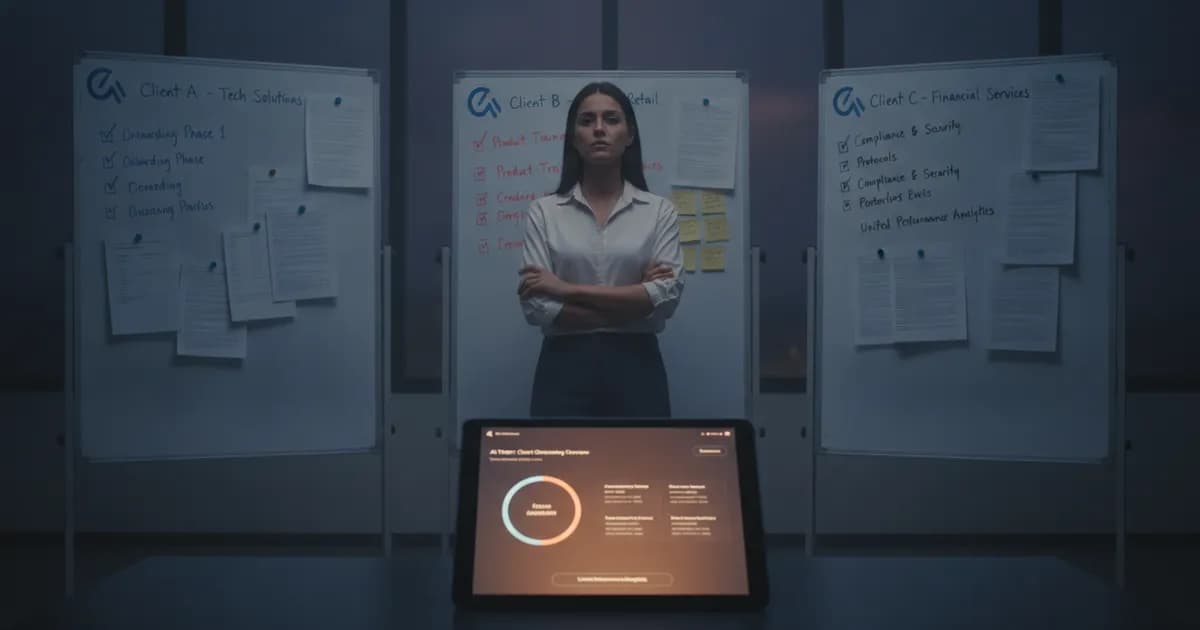
Is an AI Training Platform Worth It for a BPO Running Multiple Client Accounts
A training manager at a mid-sized BPO has three active client accounts this quarter. Each one has its own SOP binder, its own certification test, and its own idea of what "ready to take calls" means. Her team builds and rebuilds the same onboarding deck three different ways, then does it again when Client B changes its refund policy. Somewhere in a vendor deck on her desk is a pitch for an "AI training platform" that promises to fix this. The question she actually needs answered is not whether t

AI Roleplay Tools vs Live Coaching Software: Where Each One Fits in Your Stack
Two vendor demos land on your calendar for the same Thursday. One is an AI roleplay platform that has your new hires practicing objection handling with a simulated customer before their first live call. The other is a real-time coaching tool that whispers prompts into an agent's ear while they are on the phone with an actual customer. Both reps use the word "coaching." Both show a dashboard with scores. Your finance lead wants to know why you need both, or whether one can just replace the other.